
The Constitution’s Article I POWERS of CONGRESS Sections 8 and 10: 7 TRUTHS
What Our States can do to restore State and Citizen SOVEREIGNTY: Amendment 10, the final "Bill of Rights" Amendment of the 1st Congress.
The Founding Documents: Declaration of Independence, Constitution, The Federalist Papers: Alexander Hamilton's "One Great American System," James Madison's "Pyramid Powers Classes," John Jay's "Senate"
Links below take you to product pages to purchase and download documents to help in governing our States.
Our Republic as the Constitutional Convention Defined It: James Madison Federalist No. 39, The Conformity of the Plan [of the Constitutional Convention] to Republican Principles, abolished by Amendment 16, 17 and the Federal Reserve Bank:
1. A republic is defined as “a government that derives all its powers directly or indirectly from the great body of the people.”
2. Republican government must be "derived from the great body of our society, not from either an inappropriate or favored class of people." [Alexander Hamilton’s ideal: the “merchant class” store owners and mangers]
3. Persons administering Republican government must be appointed either directly or indirectly by the people; and serve for limited terms.
4. A Republic reflects the constitutions of every State in the Union. Highest offices, like the President, and members of Congress serve for limited terms.
5. Comparing our Constitution with these standards, the great body of the people elects the House of Representatives immediately. The Senate derives its appointment indirectly from the people. [States are always to appoint their own Senators]
6. The most decisive proof of a republican “system is the absolute prohibition of titles of nobility under both federal and the State governments, and express guaranty of a republican form” for each of them.
7. The FEDERAL UNION is a CONFEDERACY of Sovereign States NOT a NATIONAL CONSOLIDATION of those States.
"The two great points of difference between a democracy and a republic are: first, the delegation of the government, in the latter, to a small number of citizens elected by the rest; secondly, the greater number of citizens, and greater sphere of country, over which the latter may be extended," James Madison, Federalist No. 10: "From this view of the subject it may be concluded that a pure democracy, by which I mean a society consisting of a small number of citizens, who assemble and administer the government in person, can admit of no cure for the mischiefs of faction." ... Hence it is that [ancient national] democracies have ever been spectacles of turbulence and contention; have ever been found incompatible with personal security or the rights of property; and have in general been as short in their lives as they have been violent in their deaths."
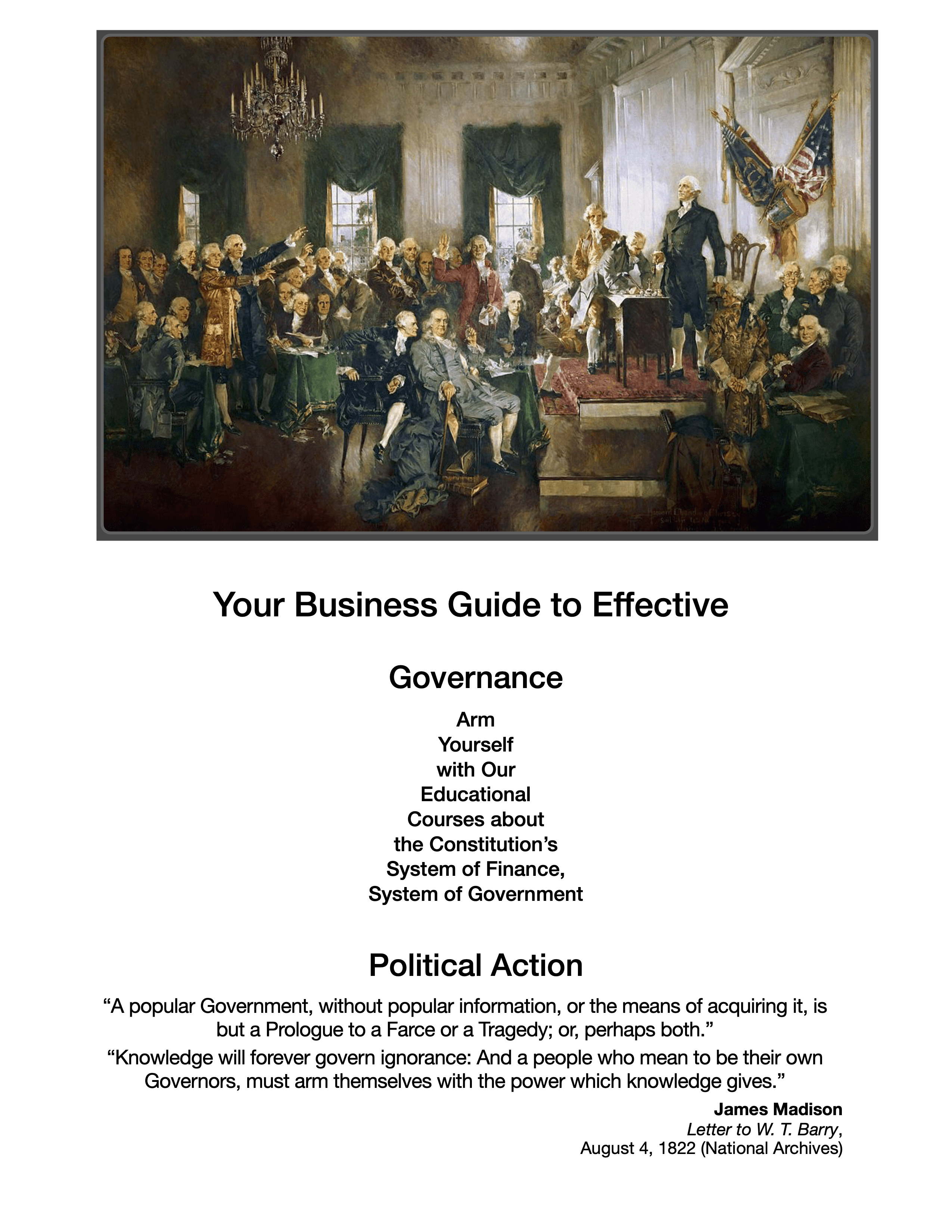
Small group teams, are successful because everyone has a voice, the only place "Democracy" works is with teams of 3 to 5 individuals (4 is ideal) to accomplish large scale system project innovations. The Constitutional Convention of 1787 had many expert small group teams, each with unique responsibilities, led by George Washington on the System of Government, advised by Supply Chain and Trading Specialist Alexander Hamilton, Scientist and Businessman Ben Franklin, and Organizational Structure and Power Specialist James Madison -- all there were great organization, administrative, and legal minds of national stature.
For Interested Citizens - Our MONEY, State REVENUE, Federal BANK
The Constitution's Article I Section 8 Clause 5 "coining" money is followed by "Punishment of counterfeiting the Securities and current Coin of the United States" Clause 6, money made in imitation to make it look real; "not genuine;" as in "fiat" dollars. Further, Section 10, the first Clause, States can not "make any Thing but gold and silver Coin a Tender in Payment of Debts;" all of which requires "paper" money "securities" to have gold and silver "Coin" circulating as "anchor" for the highest and lowest denominations of paper currency.
Our State Governments have powerful tools to regulate, control and mange the Federal Government when it usurps State Powers "The unlawful seizure and assumption of another’s [power or] position, office, or authority [without any right to do so]," the definition of"usurpation" from Black’s Law Dictionary®. Federalist Papers reveals this was our Founder's greatest fear of Congress. Some State leaders, like South Carolina's Conatitution, have backing to restore our Republican Constitution and our Money.
The U.S. CONSTITUTION Depicted, 7 TRUTHS - The UNION of STATES and SYSTEM of GOVERNMENT and FINANCE
More from The Federalist Papers:
1 POWERS of CONGRESS The Constitution’s Article I Section 8 – 7 TRUTHS of the Founders
2 God's First and Greatest Empire - PERSIAN EMPIRE a Model Government
3 Science Sketch of How We THINK, LEARN and ACT - Philosophy
4 IMAGE of the REPUBLIC - The Great Seal of the United States
5 STATES Restraint of Congress CHRISTMAS 1787 and NEW YEARS DAY 1788 Federalist Papers
6 The SYSTEM of FINANCE Strategy of Alexander Hamilton
7 How WE and Our STATES CHANGE WASHINGTON
The ConstitutionPower Series of Courses is a Spy Satellite System Cold Warrior's examination of The Federalist Papers of Alexander Hamilton, James Madison, and John Jay
"A rule of law contained in the Constitution prevails over any act, policy, or practice of government inconsistent with that Constitutional rule. But who properly has the power to interpret and apply the Constitution? The text of the Constitution simply does not say."
[from Paulsen, Calabresi, McConnell and Bray, The Constitution of the United States Thomson Reuters/Foundation Press, New York, NY; 2010, (with legal disclaimer).]
It's Ours to Interpret from The Federalist Papers…